
Smith & Wesson Model 29 "Dash" Variants and "Pinned and Recessed," Explained
Posted by Mike Walter on Jul 21st 2026
If you're researching a Smith & Wesson Model 29 — maybe to buy one, maybe because you inherited one — you'll quickly run into two pieces of jargon: the "dash" numbers (29-2, 29-3, and so on) and the phrase "pinned and recessed." Both have a real effect on what a given revolver is worth and how collectible it is. Here's what they mean in plain English.
A quick history. The Model 29 is Smith & Wesson's large-frame (N-frame) revolver chambered in .44 Magnum, introduced in the mid-1950s. It was already respected among handgun hunters and shooters when a 1971 film put it on every magazine cover and turned "the most powerful handgun in the world" into a marketing line. Demand outran supply for years, and the Model 29 became one of the most iconic American revolvers ever made.
What the dash numbers mean. Smith & Wesson didn't redesign the Model 29 every few years — it refined it. Each significant engineering change earned a new "dash" suffix: the original Model 29, then the 29-2, the 29-3, and onward. So the dash number is essentially a date stamp for which generation of the revolver you're holding. Earlier dashes (like the 29 and 29-2) come from the era before certain cost-saving production changes, which is a big reason collectors seek them out.
What "pinned and recessed" means. This is the phrase that separates casual sellers from people who know the gun.
- Pinned refers to the barrel: a small cross-pin runs through the frame to lock the barrel in place. You can often spot the pin as a tiny flat circle on top of the frame where the barrel threads in.
- Recessed refers to the cylinder: the back of each chamber is counterbored so the cartridge rim seats flush, fully enclosed by the cylinder face.
Smith & Wesson used both features on its magnum revolvers for decades, then phased them out in the early 1980s. Because of that cutoff, "pinned and recessed" has become collector shorthand for made before the change — and, generally, more desirable. Two Model 29s in similar condition can carry noticeably different value based on whether they're P&R.
How to tell what you have. Look for the dash number stamped on the frame (usually under the crane, visible when the cylinder is open), check for the barrel pin, and open the cylinder to see whether the chambers are counterbored. The serial number helps date it, too — Smith & Wesson's numbering shifted over the years, so a dealer who knows the model can usually pin down the era quickly. If any of that is unfamiliar, that's normal; it's exactly the kind of thing worth having a knowledgeable dealer confirm before you buy or sell.
What this means for value. In rough order, collectors weigh: originality (all-original finish and parts), condition (finish wear, mechanical tightness, cylinder lockup), the dash/era (earlier and pinned-and-recessed tends to bring more), barrel length, and whether the box and paperwork survived. Condition and originality usually matter most — a clean, honest, unmolested revolver almost always beats a rare variant that's been refinished or altered.
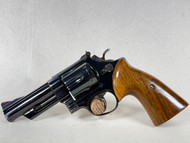
See a real one. If you want a reference point for what a clean, collectible example looks like, we currently have an early-1960s Model 29-2, pinned and recessed in the case — deep blue finish, walnut target grips, mechanically tight. It's a good yardstick for the condition and features described above.
Inherited a .44 Magnum? If a Model 29 came to you as part of a family estate and you're not sure what it is or what it's worth, that's exactly what we do. We're an Arizona estate-liquidation dealer backed by retired law enforcement, and we help families identify, fairly value, and sell inherited firearms with zero pressure. Reach out here — even if you just want to know what you have.